
Dental Implant vs Bridge: Which Is Right for You?
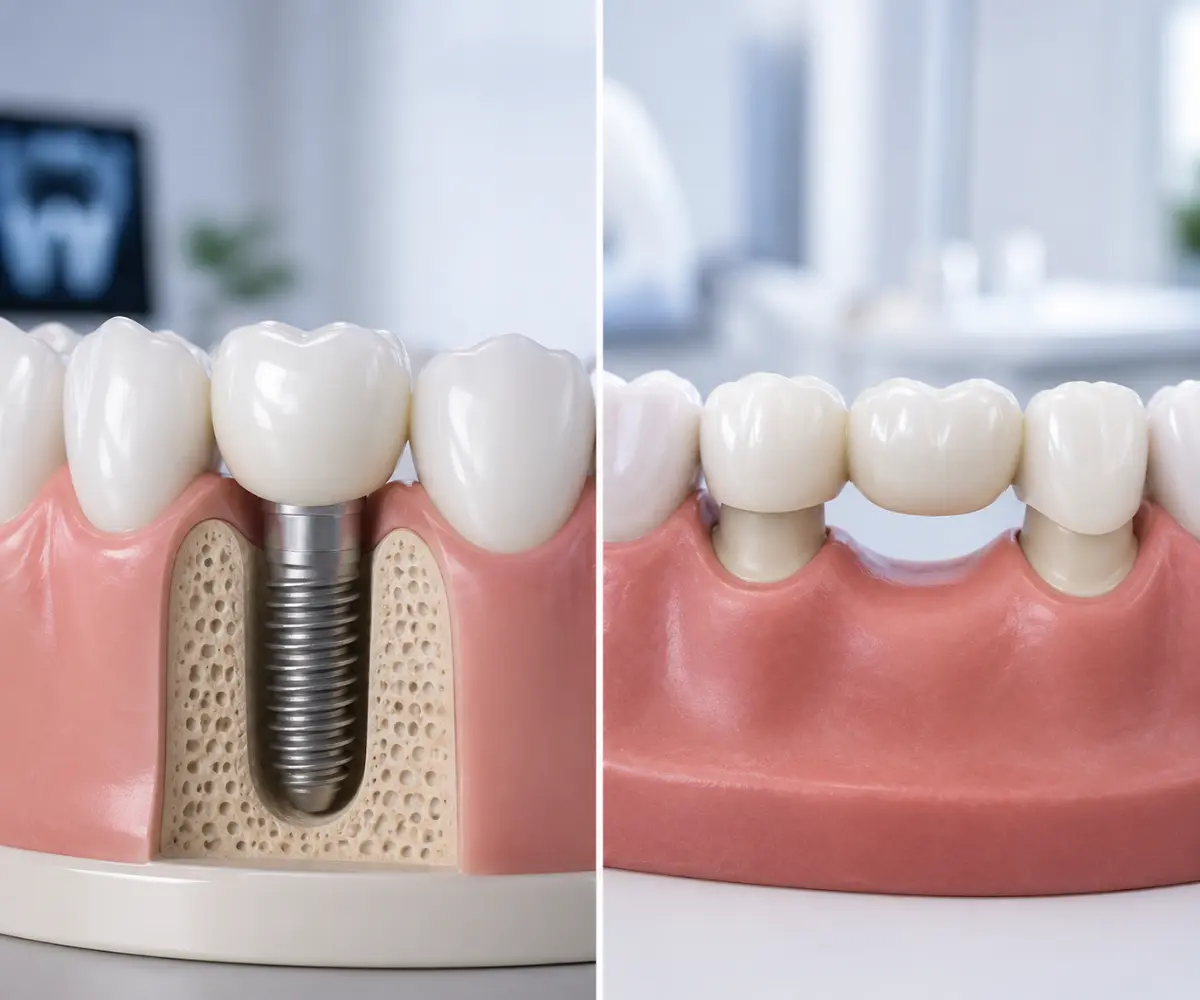
Both dental implants and bridges are proven options for replacing a missing tooth. An implant replaces the tooth root and preserves jawbone without involving adjacent teeth. A bridge spans the gap using the neighboring teeth as anchors and can often be completed more quickly with lower upfront cost. The right choice depends on your bone health, the condition of adjacent teeth, your budget, and your timeline. A clinical evaluation is the only way to determine which option is appropriate for your case.
Transparent Evaluation. No Pressure.
We walk you through all available options before you decide.
 Full clinical evaluationBoth options explainedSame-day consultations available
How Each Option Works
Understanding the mechanics of each option helps you evaluate the trade-offs more clearly.
Dental Implant
A titanium post placed surgically into the jawbone as an artificial tooth root, topped with a custom crown once the bone has fully bonded to it.
- 1
Post Placement
The titanium post is placed surgically into the jawbone and the site is allowed to heal.
- 2
Osseointegration
Over several months, the jawbone bonds to the post, creating a stable foundation for the restoration.
- 3
Crown Placement
An abutment connector and custom crown are attached above the gumline to complete the tooth.
Treatment typically spans several months to allow proper bone integration before the crown is placed.
Dental Bridge
A fixed restoration that spans a gap by anchoring to the natural teeth on either side, with a false tooth (pontic) suspended between them.
- 1
Tooth Preparation
The two teeth adjacent to the gap are permanently reshaped to accept the anchor crowns.
- 2
Impression and Fabrication
A mold is taken and the bridge — two crowns plus a pontic — is fabricated to match your surrounding teeth.
- 3
Cementation
The completed bridge is cemented onto the prepared anchor teeth, closing the gap.
A bridge can typically be completed in two or three appointments over a few weeks, with no healing period between stages.
Implant vs. Bridge: Side-by-Side
The table below covers the most clinically relevant differences. Individual outcomes vary by patient and case.
Upfront Cost
Dental Implant
Typically higher; post, abutment, and crown are priced separately, and preparatory work may add to the total.
Dental Bridge
Typically lower; two anchor crowns and a pontic completed in one procedure, no surgery required.
Treatment Duration
Dental Implant
Several months — the post must integrate with the jawbone before the crown can be placed.
Dental Bridge
Usually 2–3 appointments over a few weeks; no healing period required between stages.
Effect on Adjacent Teeth
Dental Implant
None — the implant stands independently without involving neighboring teeth.
Dental Bridge
The two teeth on either side must be permanently reshaped to support the anchor crowns.
Jawbone Preservation
Dental Implant
The titanium post stimulates bone, helping prevent the resorption that follows tooth loss.
Dental Bridge
Does not replace a tooth root; bone under the pontic may continue to resorb over time.
Appearance
Dental Implant
Closely replicates a natural tooth; crown emerges from the gumline as a single unit.
Dental Bridge
Matches adjacent teeth in color and shape; gum recession near the pontic may become visible over time.
Longevity
Dental Implant
Post designed for long-term use; crown may need replacement after many years.
Dental Bridge
Can last many years; subject to wear and decay at the crown margins over time.
Maintenance
Dental Implant
Brush and floss normally, the same routine as natural teeth.
Dental Bridge
Requires cleaning under the pontic using a floss threader, interdental brush, or water flosser.
| Category | Dental Implant | Dental Bridge |
|---|---|---|
| Upfront Cost | Typically higher; post, abutment, and crown are priced separately, and preparatory work may add to the total. | Typically lower; two anchor crowns and a pontic completed in one procedure, no surgery required. |
| Treatment Duration | Several months — the post must integrate with the jawbone before the crown can be placed. | Usually 2–3 appointments over a few weeks; no healing period required between stages. |
| Effect on Adjacent Teeth | None — the implant stands independently without involving neighboring teeth. | The two teeth on either side must be permanently reshaped to support the anchor crowns. |
| Jawbone Preservation | The titanium post stimulates bone, helping prevent the resorption that follows tooth loss. | Does not replace a tooth root; bone under the pontic may continue to resorb over time. |
| Appearance | Closely replicates a natural tooth; crown emerges from the gumline as a single unit. | Matches adjacent teeth in color and shape; gum recession near the pontic may become visible over time. |
| Longevity | Post designed for long-term use; crown may need replacement after many years. | Can last many years; subject to wear and decay at the crown margins over time. |
| Maintenance | Brush and floss normally, the same routine as natural teeth. | Requires cleaning under the pontic using a floss threader, interdental brush, or water flosser. |
All comparisons are general. Your treatment plan, existing oral health, and specific anatomy affect outcomes for both options.
Which Option Fits Your Situation?
The right choice depends on bone health, the condition of adjacent teeth, timeline, and budget. These factors help guide the decision.
An Implant May Be Better When
- Sufficient bone density exists at the extraction site
- Adjacent teeth are healthy and should not be permanently modified
- Long-term replacement with straightforward daily maintenance is the goal
- Preserving jawbone at the extraction site is a priority
- Medical clearance for minor oral surgery has been confirmed
- A single tooth needs replacing without involving adjacent teeth
A Bridge May Be Better When
- Bone density is insufficient and grafting is not preferred
- Adjacent teeth already have crowns or significant existing restorations
- A shorter treatment timeline is needed
- Implant surgery is not currently medically appropriate
- Lower upfront cost is the determining factor
- Multiple consecutive teeth are missing, making individual implants less practical
Three Questions That Guide the Decision
Your provider works through these three areas at your evaluation to determine which option is clinically appropriate for you.
Assess Bone Health
X-rays or a 3D scan confirm whether enough bone volume exists for an implant, or whether grafting would be needed first.
Review Adjacent Teeth
Healthy, unrestored neighboring teeth favor an implant. Teeth with existing crowns or restorations may make a bridge the more efficient choice.
Discuss Timeline and Budget
Your provider walks through the cost and schedule for both options so you can decide before any treatment begins.
- 1
Assess Bone Health
X-rays or a 3D scan confirm whether enough bone volume exists for an implant, or whether grafting would be needed first.
- 2
Review Adjacent Teeth
Healthy, unrestored neighboring teeth favor an implant. Teeth with existing crowns or restorations may make a bridge the more efficient choice.
- 3
Discuss Timeline and Budget
Your provider walks through the cost and schedule for both options so you can decide before any treatment begins.
Why Choose Silver State Smiles?
Our team evaluates both options honestly and explains the trade-offs for your specific case before recommending a treatment path.
Both Options Available
We place implants and fabricate bridges in-house, so the recommendation is based on your case rather than what we offer.
3D Imaging for Accurate Evaluation
Cone beam CT scans provide a precise view of bone volume and anatomy, making implant planning more predictable.
Multiple Las Vegas Locations
Several offices across the valley let you complete your full treatment close to home.
Benefits Verification Before You Commit
We request insurance benefits verification before treatment begins so you have a clear estimate of your out-of-pocket cost.
Flexible Financing Available
In-house and third-party financing options let you spread the cost over monthly installments.
Patients Reviews
Trusted by Patients Across Every Corner of Nevada
Hear what our patients have to say about their experience at Silver State Smiles. We are proud to provide exceptional care that transforms smiles and lives.

Award-Winning Excellence
Recognized as the Best of Las Vegas 2025
We're honored to be recognized as a Gold Winner by the Las Vegas Review-Journal. This prestigious award reflects our commitment to providing exceptional dental care and outstanding patient experiences.
Trusted by thousands of patients
Dental Implant Guides
Dental Implant Cost in Las Vegas
Transparent pricing, cost factors, and financing options.
Read guideImplant vs. Denture: A Full Comparison
Which replacement option fits your lifestyle and budget.
Read guideAre You a Candidate for Dental Implants?
Health criteria, age factors, and disqualifying conditions.
Read guideDental Implants With Bone Loss
Options when there isn't enough bone for a standard implant.
Read guideHow Long Do Dental Implants Last?
Success rates, failure causes, and maintenance tips.
Read guideSame-Day Dental Implants Explained
How immediate-load implants work and who qualifies.
Read guideDental Implant Recovery: What to Expect
Week-by-week recovery stages and what to watch for.
Read guideAre Dental Implants Worth It?
Long-term value, longevity data, and patient outcomes.
Read guideWatch & Learn
Short videos from our team on dental implants, smile makeovers, and what to expect.
How to Stop Hiding Your Smile: Mirror Anxiety to Morning Confidence with Implants
How Traveling to Las Vegas for a Dental Implant Smile Makeover Is Possible
How to Upgrade Your Smile: Replacing Failing Veneers With Lifetime Zirconia Crowns
Ready to Find Out Which Option Is Right for You?
Book an evaluation and our team will review your bone health, adjacent teeth, and treatment goals before recommending a path forward.
Whether it's your first visit or your fiftieth, we'll make it feel easy.
Frequently Asked Questions
Cannot find the answer you are looking for? Contact our friendly team at (702) 780-0232orcontact us.